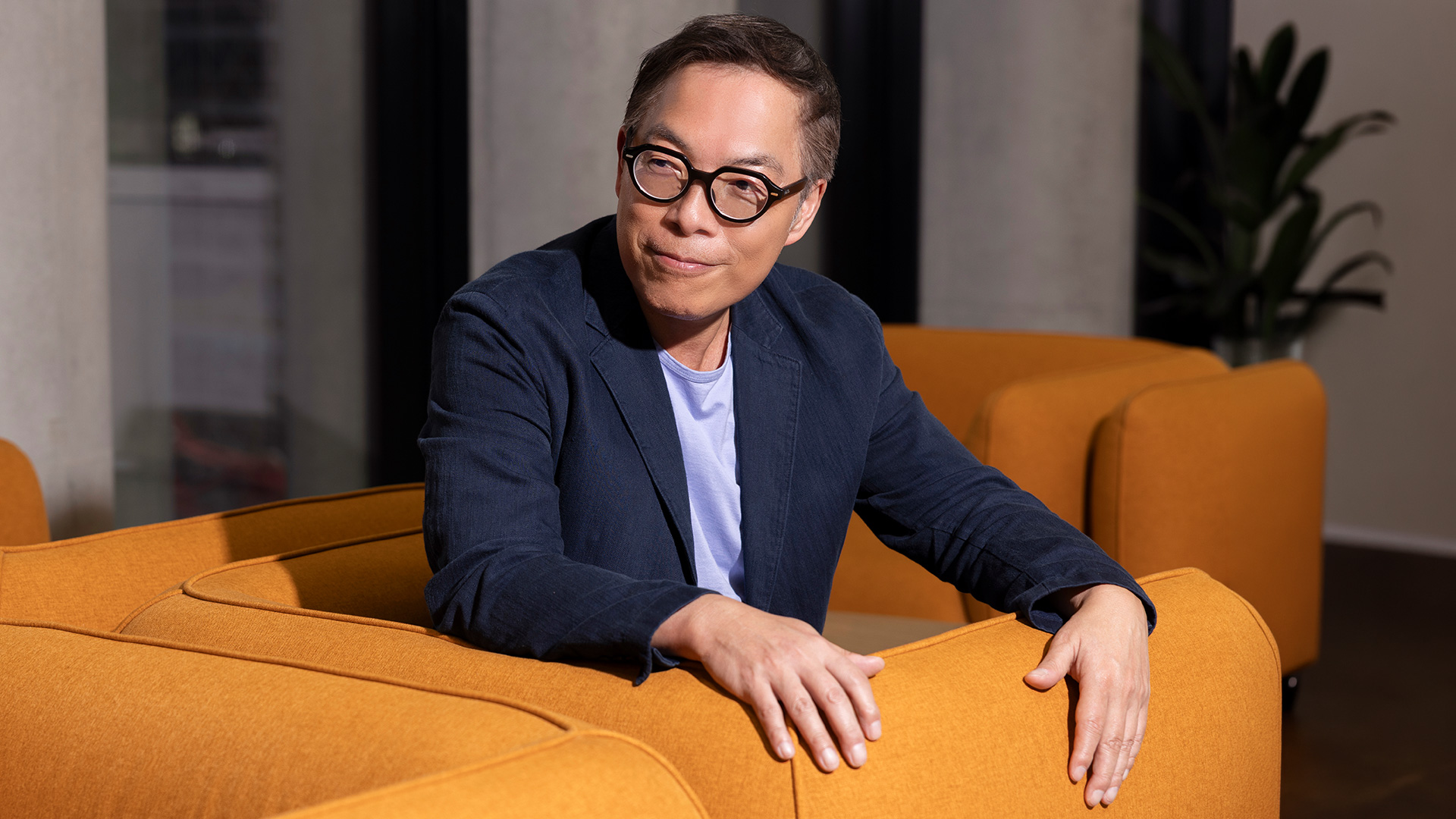

Game Changer: Journeying through the many wondrous worlds of great escape-room entrepreneur Rick Woo
When we arrive at LOST’s Causeway Bay outlet on a sunny autumnal morning, the atmosphere is unexpectedly peaceful. Nuzzled among the mass of commercial and retail buildings that converge into a narrow path, the space exudes an almost surreal calm. Rick Woo, co-founder of the rapidly expanding escape-room enterprise, welcomes us with a warm smile and an unusual offer: a shot of whisky, his go-to drink, to give the production team a liquid-energy boost. We laugh, accepting the toast to creativity, and step inside.
As Woo leads us up a steep set of stairs and along deserted rooms on the upper floors, it’s easy to feel like we’ve entered an alien laboratory or a Wild-West hideout. The walls are alive with colours, evoking a sense of wonder and curiosity. One escape room resembles an American diner, nostalgic and lively; another hints at a prison cell, dark and mysterious.
Dressed in a loose black-and-white ensemble, Woo is effortlessly chic, embodying the spirit of a lively storyteller and innovator. Though now approaching 50, he could pass for someone 20 years younger, perhaps due to all that cardio (see his content on Strava and Instagram), or maybe because of his surroundings, a playground of imagination, where every corner tells a story.
Young Puzzle Master
Woo’s journey into the world of immersive entertainment began long before LOST’s 2013 launch. His childhood in Hong Kong revolved around a love for problem-solving. “I grew up fascinated by puzzles and mysteries, and I loved solving problems that seemed impossible,” he recalls. “As a kid, I often created small games for my friends using paper clues and homemade locks. I didn’t realise it then, but I was already designing ‘escape games’ in my own way.”

His parents, small business owners, played a significant role in shaping his mindset. “Watching them taught me perseverance, responsibility and creativity in finding solutions when things didn’t go as planned,” the University of South Australia alumnus says. “That blend of curiosity and entrepreneurial thinking is what set the foundation for everything I’ve done.”
By 2013, after working in the telecommunication industry in Hong Kong and Melbourne, Woo’s ambition was clear – to bring the thrill of escape rooms to his home city and beyond. “Escape games were almost unheard of in Asia back then,” he explains. “I wanted to create something that didn’t just entertain but challenged the mind and connected people. The idea was simple: bring stories to life through immersive experiences where players could feel like the heroes of their own adventures.”
LOST was born from this vision: a space where people could ‘get lost’ in the moment, forget about their phones, and rediscover the joy of teamwork and problem-solving. The concept resonated quickly, and the brand burgeoned; it now operates 14 outlets worldwide. Yet, Woo’s journey was only just beginning.
Power of Curiosity
Travelling and engaging with diverse cultures broadened his perspective. “Meeting people from different backgrounds taught me that curiosity is universal,” he notes. “Whether in Hong Kong, Taiwan, Australia or the Philippines, people love to explore and challenge themselves.”
His personal transition from a tech enthusiast to an entrepreneur helped bridge the physical and digital worlds. “LOST keeps evolving because we respect local culture but also use global creativity to connect everyone through play and storytelling,” he explains. This blend of cultural sensitivity and innovative technology has been key to the brand’s global success.

Building an international chain had its hurdles. “In the beginning, many didn’t understand what an escape room was,” he admits. “We had to educate the market from zero.” Scaling the business across different countries, maintaining quality, and ensuring creative consistency were daunting tasks. “The key was building a passionate team who shared the same belief: to let the world fall in love with creative problem-solving,” he says.
Every obstacle was turned into a puzzle, each challenge an opportunity to innovate. “We approached every difficulty with the mindset of a game designer,” he laughs. “If you get stuck, you just need to find the next clue.”
New Realities
LOST’s evolution into a multifaceted ecosystem was driven by a simple question: how can the experience become more meaningful? This led to the birth of LOST Junior, LOST Studio and LOST Island. Each initiative embodies Woo’s core philosophy of creativity, learning and connection. Looking ahead, he envisions a future where entertainment, education and technology are seamlessly integrated.
“The future lies in blending worlds,” he says. “AR, blockchain and interactive storytelling will make learning experiential, engaging and personalised. Imagine classrooms where students create and live their own adventures.”
He is most excited about innovations in AI, AR and mixed reality. “Games that adapt to your behaviour, puzzles that evolve with your intelligence – these will transform how we learn, teach and connect,” he predicts, viewing technology as a tool to expand creativity and foster a new era of immersive storytelling.

His vision for LOST has expanded from physical spaces to ecosystems that merge online and offline worlds. “Our mission remains the same: to make the world fall in love with creative problem-solving,” he affirms.
For Woo, joy comes from seeing people smile after solving a puzzle, or witnessing a child’s confidence bloom during a LOST Junior adventure. “The moment of ‘Aha!’, that’s happiness,” he says. Success, he believes, is measured by impact. “When LOST inspires people to think differently, learn creatively and connect meaningfully, that’s true success.”
More to be Found
Woo harbours plans for further expansion across Asia and onto other continents, aiming for 30 branches within three years. R&D investments in digital tokens, creator tools and AR experiences are already underway. “LOST will evolve into a global hub for creativity, education and innovation,” he envisions.
His advice to aspiring entrepreneurs? “Start with why. Don’t chase trends. Solve real human problems and never fear failure. Every mistake is just another puzzle to solve.”
He believes the most important skill participants gain is creative problem-solving. “In life and business, there’s rarely a single right answer,” he says. “LOST trains you to observe, think laterally, and work with others under pressure – skills that are vital in the real world.”
The Final Scene
He finds fulfilment in inspiring others; seeing children design their first game or a team rediscover the power of collaboration. “My legacy? I want LOST to be a global symbol of creativity, education, and unity,” he declares. “I hope more people fall in love with solving problems, not avoiding them.”
As we both utter “that’s a wrap!”, Woo’s world feels like stepping into a movie, an experience as meta as that sounds. It’s reminiscent of the final scene in Steven Spielberg’s Raiders of the Lost Ark, where the golden chest is sealed inside a wooden crate, wheeled through a cavernous warehouse, and stored away from enemies. The end credits roll, and the adventure pauses, waiting for the next chapter.
In Rick Woo’s universe, every game, every puzzle, every story is an invitation to enter a world of infinite possibilities, where imagination is the only limit, and the journey of discovery never truly ends.
Interview, Text & Art Direction: Joseff Musa Photographer: Jack Law Videographer: Iris Ventura