

Taipei Whispers: Discover how Taiwan’s capital seamlessly blends historic spiritual sanctuaries with futuristic urban ambition
There is a distinct, intoxicating rhythm to Taipei that catches you entirely unawares. For the uninitiated, Taiwan’s capital initially presents itself as a dizzying kaleidoscope of neon, concrete, and the unrelenting hum of a million scooters waiting for the light to turn green. It wears the utilitarian armor of a mid-century Asian miracle town.
To understand Taipei, one must start where the river meets the lowlands. Long sensory memories before Taipei was a tech hub, it was a cluster of trading ports along the Tamsui River. The neighborhoods of Wanhua and Datong preserve this foundational DNA with a stubborn, beautiful pride. Your journey begins in Wanhua, Taipei’s oldest district. Here stands Longshan Temple, a sprawling spiritual sanctuary built in 1738. To step through its gates is to step through a portal in time. The air is thick and sweet with the smell of burning incense. Elderly locals sit on low stools, rhythmically chanting sutras, while younger professionals in sharp corporate suits stop by on their morning commutes, tossing crescent-shaped wooden blocks onto the stone floor to seek divine guidance on career moves or relationships. Longshan is not a museum piece; it is the living, beating heart of community life. The temple walls, adorned with intricate dragon carvings and colorful porcelain shards, have survived earthquakes, fires, and the bombings of World War II. It stands as a testament to the resilient, welcoming spirit of the Taiwanese people.

A short hop north takes you to the Datong District, home to Dihua Street in the historic Dadaocheng area. This is Taipei’s oldest commercial street, famous for its beautifully restored Baroque and Fujianese style shophouses. Walking down Dihua is an assault on the senses in the best possible way. The air smells of dried shiitake mushrooms, Chinese medicinal herbs, premium bird’s nest, and locally roasted tea leaves. In recent years, Dihua Street has undergone a magnificent renaissance. Old, multi-generational medicine shops now sit side by side with third-wave espresso bars, artisan ceramic studios, and microbreweries. It is a masterclass in urban preservation, a place where millennials and octogenarians share the same pavement, united by a mutual respect for heritage.
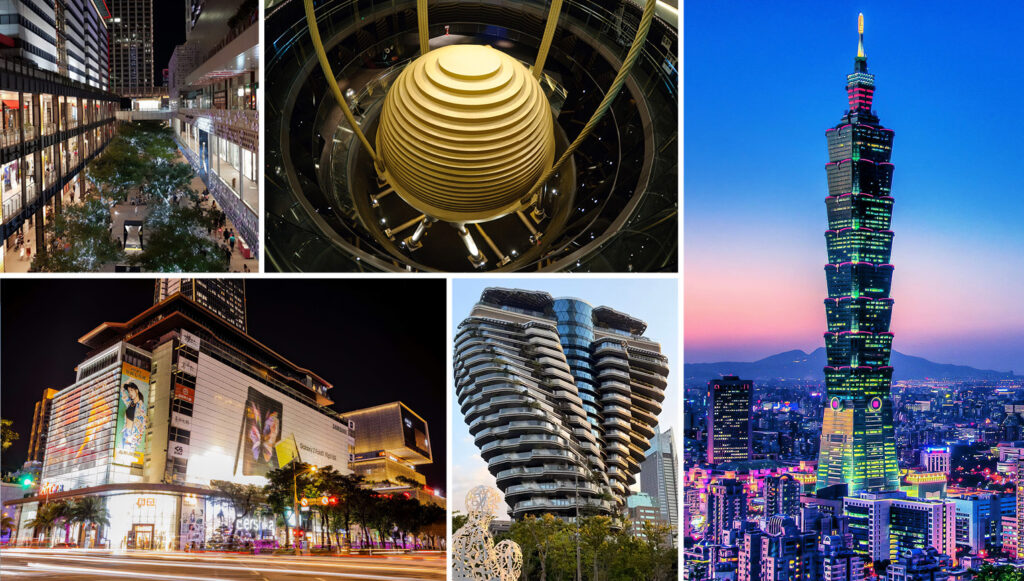
If Wanhua is Taipei’s soul, the Xinyi District is its ambition. This is the city’s glittering financial center, a sprawling grid of wide, immaculate avenues, high-end shopping malls, and architectural showpieces. Dominating this landscape is Taipei 101, the engineering marvel that held the title of the world’s tallest building from 2004 to 2010. Designed to resemble a giant stalk of green bamboo rising out of the earth, the tower is a brilliant fusion of postmodern design and traditional Feng Shui principles. Taking the world’s fastest pressurized elevators up to the 89th-floor observatory is a rite of passage. On a clear day, the view is staggering: a vast, dense concrete jungle completely hemmed in by lush, emerald green volcanic mountains. But the most fascinating sight isn’t outside; it’s inside. Hanging in the center of the tower is a massive, 660-metric-ton gold-painted steel pendulum, the tuned mass damper. It is a stunning piece of engineering left entirely visible to visitors, designed to sway and counteract the violent tremors of typhoons and earthquakes, keeping the giant building stable. At ground level, Xinyi moves with a cosmopolitan swagger. Elevated walkways connect over a dozen luxury department stores, allowing shoppers to glide seamlessly above the traffic. By day, it is a hive of corporate energy; by night, street performers, jazz musicians, and upscale cocktail bars turn the plaza into a vibrant, open-air cultural salon.
In Taipei, the standard greeting is not “How are you?” but whether you have eaten yet. Food here is not merely sustenance; it is a cultural obsession, a daily ritual, and a form of artistic expression. When the sun dips below the horizon, Taipei truly wakes up, lit by the glowing signs of its legendary night markets. While tourists flock to the massive Shilin, locals often head to smaller, food-focused enclaves like Raohe Street Night Market or Ningxia Night Market. To experience a Taipei night market is to embrace a joyful, chaotic culinary pilgrimage. At the entrance of Raohe, wait in the inevitable line for the famous Fuzhou Black Pepper Pork Buns. Baked in a traditional clay tandoor-style oven, these buns have a smoky, blistered crust that gives way to a piping hot, deeply savory filling of minced pork, scallions, and cracked black pepper. Follow the pungent, unmistakable aroma to a stinky tofu stall. Fermented in a brine of milk, vegetables, and meat, this controversial dish is fried to a shattering crisp, doused in a garlic-soy glaze, and topped with pickled cabbage. It is a flavor profile that challenges the palate but rewards the brave. End your night with a bowl of Lu Rou Fan, which consists of tender, fatty hand-cut pork belly slow-cooked in a master stock of soy sauce, five spice, and fried shallots, served over a steaming bowl of short grain rice. It is pure, unadulterated comfort in a bowl.
Beyond the street stalls, Taipei’s culinary landscape reaches the highest echelons of gastronomy. This is, after all, the birthplace of Din Tai Fung, the humble dumpling shop that grew into a global empire. Watching the chefs behind the glass partition wrap soup dumplings with surgical precision, each dumpling strictly requiring a minimum of 18 folds, is like watching a classical ballet. The explosion of hot, rich broth and tender pork inside your mouth is a moment of pure culinary euphoria. It represents the city’s broader obsession with technical perfection masked as simple comfort food, a standard that extends from the high-end noodle shops of Da’an to the simple breakfast shacks serving warm soy milk and fried dough sticks.

What truly elevates Taipei above other Asian megacities is its extraordinary proximity to nature. You are never more than 30 minutes away from a hiking trail, a thermal hot spring, or a mountain tea plantation. For the ultimate postcard view of the city, skip the crowds at the base of Taipei 101 and head to the Nangang District to climb Xiangshan, also known as Elephant Mountain. The trail consists of steep, winding stone steps carved directly into the hillside, shaded by giant ferns and tropical foliage. As you sweat your way to the top, the jungle suddenly parts to reveal the classic, unobstructed view of Taipei 101 slicing through the clouds. At sunset, as the sky turns from a soft lavender to deep indigo, and the city lights flicker to life like a field of fallen stars, you realize that Taipei’s urban chaos looks remarkably serene when viewed from the peace of the forest.
To the north lies Beitou, a historic hot spring resort district nestled at the foot of the Yangmingshan mountain range. Developed extensively during the Japanese colonial era, Beitou feels like a sleepy mountain village trapped inside the city limits. Wander into the Thermal Valley, a volcanic crater where natural sulfurous waters boil at near 100 degrees Celsius. A permanent, ethereal mist hangs over the turquoise water, earning it the nickname Ghost Lake. After breathing in the mineral-rich air, check into one of the local bathhouses for a restorative soak in the milky white sulfur waters, the perfect antidote to miles of city walking. The transition from asphalt to sulfur pools is remarkably swift, illustrating how closely the city’s inhabitants live alongside the geothermal energy of the island.
Taipei is a city that understands the luxury of slow living. Amid the hustle, it is a paradise for bibliophiles. The city’s independent bookstores are legendary, but none hold a candle to the legacy of Eslite. Though the iconic 24-hour Dunnan branch has passed into history, Eslite’s flagship locations continue to operate as massive, multi-level cultural sanctuaries where readers are encouraged to sit on the floor, sip a coffee, and read for hours without buying a thing. It reflects a society that deeply values intellect, art, and quiet contemplation. In the alleyways of Da’an and Zhongshan, a world of design-forward cafes awaits. Taipei’s baristas take their craft incredibly seriously, sourcing single-origin beans from across the globe and roasting them in-house.

Yet, the traditional tea culture remains fiercely defended. For an unforgettable afternoon, take the Maokong Gondola cable car up to the mist-shrouded peaks above the city. Here, overlooking rolling hills of terraced tea fields, you can sit in a traditional wooden tea house, learn the intricate steps of the Gongfu Tea Ceremony, and sip authentic Muzha Tieguanyin tea as the clouds drift lazily across the valley below. The quiet clash between the third-wave espresso shops in the valley and the centuries-old tea traditions on the ridges creates a unique cultural dialogue that defines modern Taiwanese identity.
Taipei is so deeply magnetic. It is not a city of grand, aggressive monuments. Instead, it is a city of moments. It is the safety of walking down a dark alley at midnight without a shred of fear. It is the overwhelming kindness of a stranger who walks three blocks out of their way to help you find a hidden beef noodle shop. It is the smell of rain on hot asphalt mixed with the scent of sandalwood from a neighborhood shrine. Taipei doesn’t demand your awe; it quietly steals your heart. And by the time you leave, you are already planning your return to this gentle, neon-lit sanctuary at the edge of the sea.